Clinical Case
Software
3m read
A peer-reviewed study validates Atomica AI for posterior bridges.
Acceptability and efficiency of automated CAD systems in anterior and posterior FDP design
Atomica
on
Jan 17, 2026
Peer Reviewed Evaluation of Fully Automated AI CAD for 3 Unit Fixed Dental Prostheses
Acceptability, trueness, and efficiency of automated CAD systems in anterior and posterior FDP design
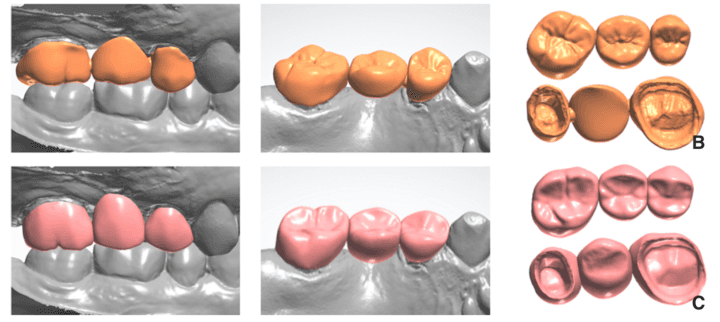
Published in The Journal of Prosthetic Dentistry, this in vitro comparative study evaluates the clinical performance of fully automated AI based CAD software programs compared with certified dental technicians in the design of anterior and posterior 3 unit fixed dental prostheses.
Background
Three unit fixed dental prostheses are a commonly used treatment for restoring partial edentulism, providing functional stability and esthetic outcomes. Long term success depends on accurate restoration design, including morphology, interproximal and occlusal contacts, connector dimensions, and pontic form. Inadequate design in these areas has been associated with biomechanical failure, caries, and periodontal complications.
While computer aided design technology has improved predictability and efficiency in prosthodontics, conventional digital workflows remain time consuming and highly operator dependent. Fully automated AI based CAD systems have demonstrated promising results for single unit crown design, but evidence supporting their performance in multi unit fixed dental prostheses has been limited.
Purpose of the Study
The purpose of this study was to evaluate the design acceptability, trueness, and efficiency of two commercially available fully automated AI based CAD software programs in designing anterior and posterior 3 unit fixed dental prostheses, and to compare their performance with restorations designed by certified dental technicians.
Materials and Methods
Thirty de identified clinical digital scans were selected, including twelve anterior and eighteen posterior 3 unit FDP cases
All scans were obtained from routine clinical care at The Ohio State University College of Dentistry and approved by institutional review board review
Each case was designed using three approaches
Certified Dental Technician using conventional CAD software
Dentbird CAD
Atomica AI
Restoration designs were evaluated by three calibrated prosthodontists using eleven standardized clinical acceptability criteria covering morphology, contacts, connectors, and pontic design
Quantitative accuracy was measured using root mean square deviation analysis
CAD design time was recorded for all systems, excluding finish line verification
Results
Design Success Rate
Dentbird successfully generated restorations for all cases
Atomica AI achieved a 93 percent overall success rate
Posterior FDPs showed a 100 percent success rate with Atomica AI
Clinical Acceptability
Atomica AI achieved acceptability scores comparable with certified dental technicians, particularly in posterior FDPs
Dentbird demonstrated significantly lower acceptability scores, especially in anterior esthetic regions
Both AI systems showed lower scores than technicians in occlusal contacts, proximal contacts, and connector design
Trueness and Accuracy
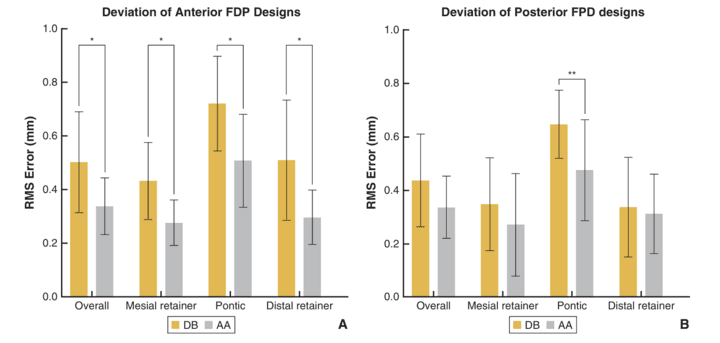
Atomica AI demonstrated significantly lower root mean square deviation than Dentbird in anterior FDPs
In posterior FDPs, Atomica AI showed significantly improved pontic accuracy
Overall deviation values for Atomica AI were consistent across anterior and posterior regions
Efficiency
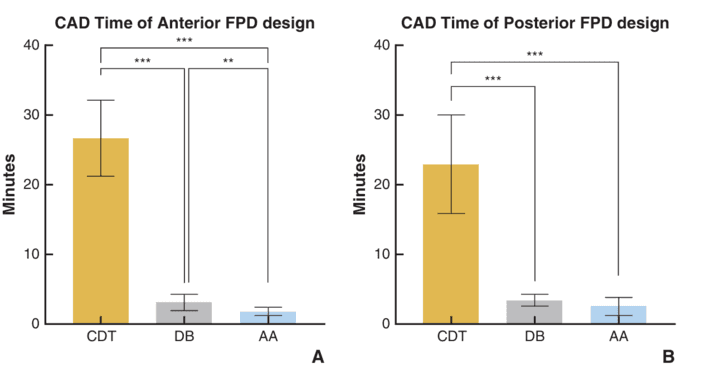
Both AI based CAD systems reduced design time from more than twenty minutes to under four minutes
Atomica AI demonstrated the shortest average CAD time among all evaluated systems
Clinical Implications
Fully automated AI based CAD systems can significantly improve efficiency in 3 unit FDP design
Posterior FDPs can be designed with clinically acceptable morphology and trueness using AI based workflows
Human supervision remains essential for anterior FDPs, occlusal and proximal contacts, and connector design
Conclusion
This study demonstrates that fully automated AI based CAD systems can deliver accurate and efficient 3 unit fixed dental prosthesis designs. Atomica AI achieved performance closest to certified dental technicians, particularly in posterior regions, while delivering substantial reductions in design time. When combined with professional oversight, AI based CAD represents a clinically viable advancement in digital prosthodontic workflows.
Publication Details
The Journal of Prosthetic Dentistry
DOI: 10.1016/j.prosdent.2025.11.034